What is plasma
Matter is commonly classified into solids, liquids, and gases, but heating a gas further can produce plasma.
Therefore, plasma is described as the ‘fourth state’ of matter.



This time, we will analyze fluorescent lamps, an industrial product that utilizes plasma.
Fluorescent lamps consist of a glass tube, a small amount of mercury, an inert gas such as argon, electrodes at both ends, and phosphor coating the inner surface of the tube.
The phosphor absorbs ultraviolet light generated by the discharge and emits visible light.
Fluorescent lamps are utilized not only in ‘residential and living spaces’ but also in the following industrial applications.
Ultraviolet Fluorescent Lamps (UV Lamps)
-
Sterilization and disinfection (medical facilities, food processing plants)
-
Air purifiers
-
Water Treatment Equipment
Blacklight
-
Counterfeit Money & Document Verification
-
Fluorescent Paint Inspection
-
Crack Inspection
The luminescence process of fluorescent lamps is as follows.
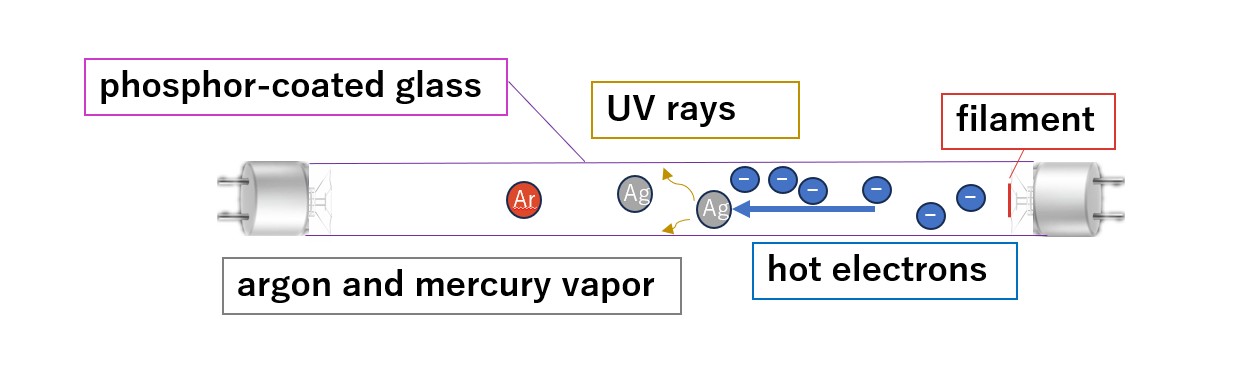
- Electrode heating and electron emission: When current flows, the electrodes (filaments) at both ends heat up, causing thermionic emission.
- Ultraviolet light generation: The discharged electrons collide with a small amount of mercury atoms sealed inside the tube. These collisions excite the mercury atoms, causing them to emit invisible ultraviolet (UV) light.
- Conversion from ultraviolet to visible light: The UV light is absorbed by the fluorescent material (phosphor) coating the inside of the glass tube. This absorption causes the phosphor to emit visible light.
The luminous efficiency of fluorescent lamps is primarily determined by the number of thermionic electrons emitted and the collision efficiency with mercury atoms.
We will calculate this process using PIC-PLASMA 3D (plasma analysis software).
Analysis of Electron-Gas Collisions in Fluorescent Lamps
Let's simulate the discharge inside a fluorescent lamp using PIC PLASMA3D.
The analysis model is as follows. (Created in FreeCAD)
Analytical model
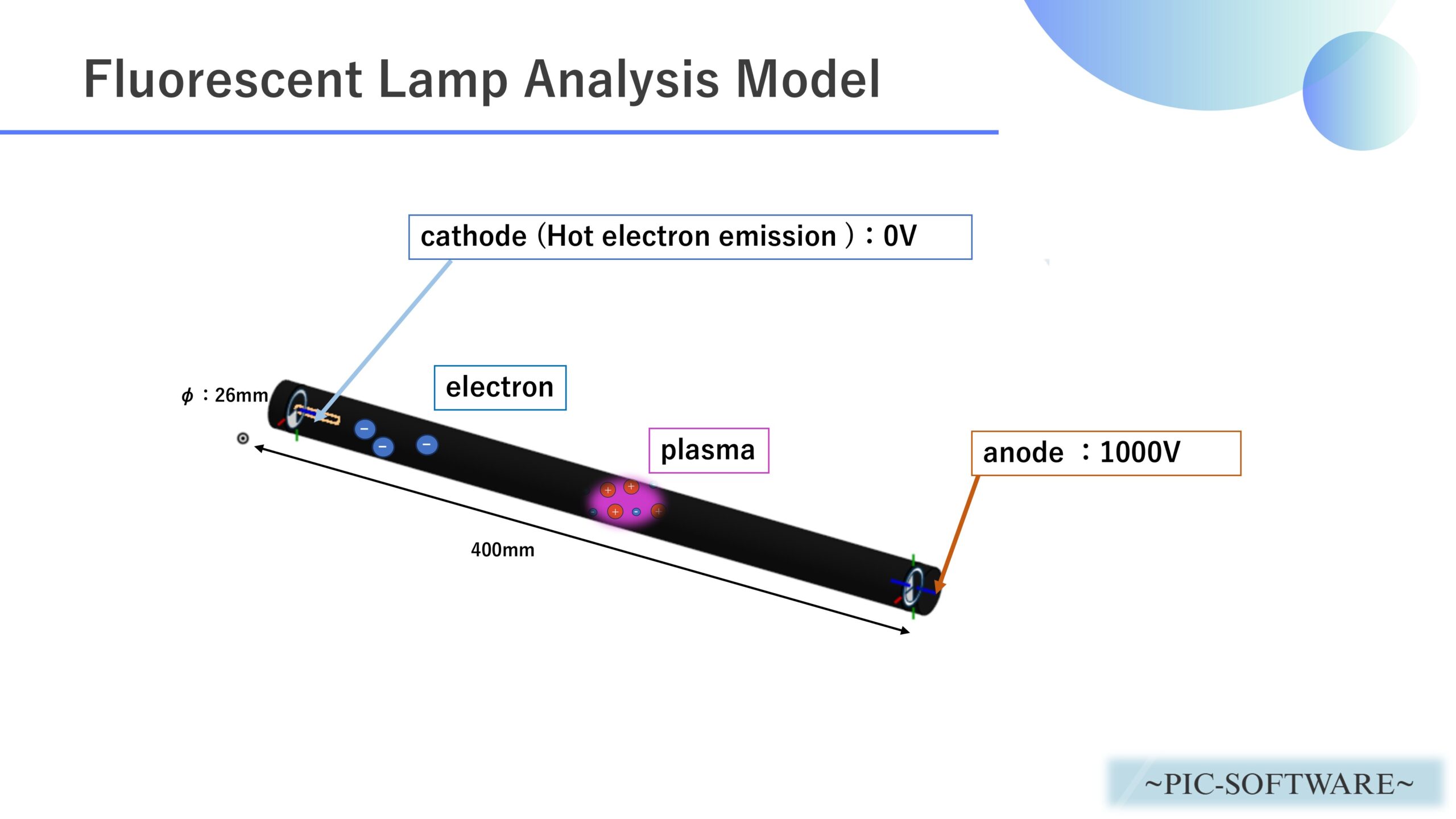
We created a fluorescent lamp analysis model as described above and performed trajectory analysis of thermionic electrons emitted from the cathode (the particles that originate plasma generation).
The plasma generation mechanism is as follows:
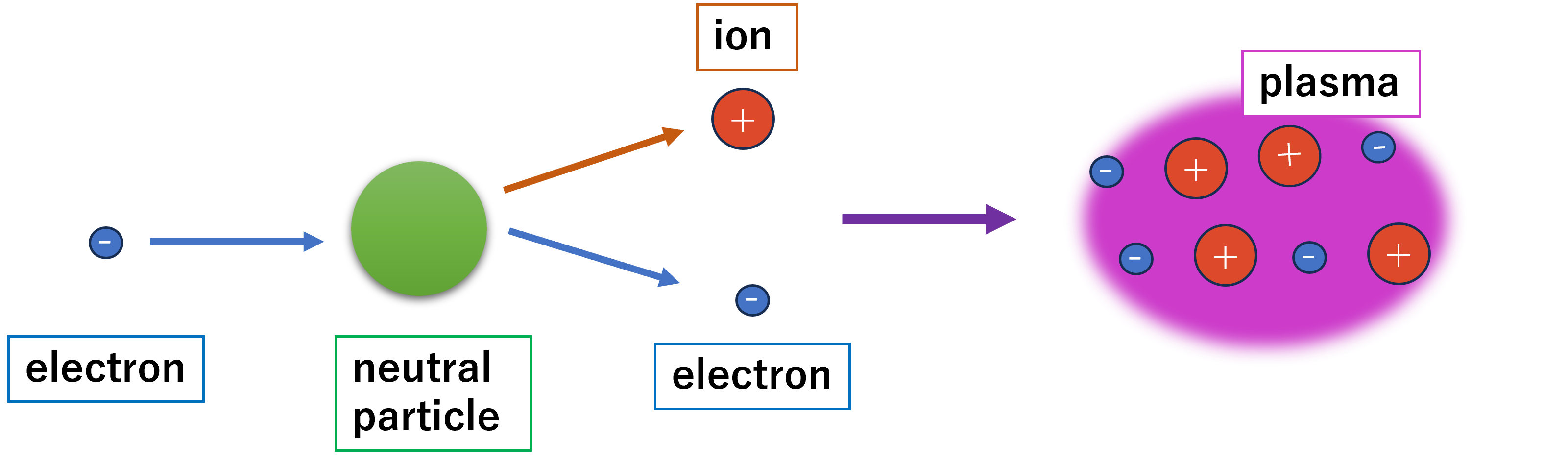
Figure 2: Plasma Generation Process
The analysis conditions are as follows.
Table 1: Analysis Conditions
| Analysis Software | PIC-PLASMA 3D |
| Analysis Type | Orbital Analysis of Plasma in an Electrostatic Field |
| Newly Generated Particle | Electron |
|---|---|
| Initial Velocity of Generated Electrons | 1.0×10⁶[m/s] |
| Number of Electrons Generated (per ns) | 1.0×10³ [per ns] |
| Voltage | Cathode Voltage: 0[V] Anode Voltage: 1000[V] |
| Time Step Width | 8.0×10⁻¹¹[s] |
| Total Simulation Time | 1.6×10⁻⁷[s] |
Analysis results
Figure 3: Analysis results of thermionic electrons emitted from the cathode inside a fluorescent lamp
Figure 4: Collision position of electrons and gas
The above materials are actual analysis results calculated using PIC-PLASMA3D.
This simulates the trajectory of free electrons emitted from the cathode, the origin of plasma generation.
Note that the “data” shown in the video represents the electron number density [particles/m³].
The CAD model used here was created simplistically, so the number of electrons and other conditions are simplified.
Additionally, PIC-PLASMA3D can output various data in addition to the above calculation results.
- Potential
- Magnetic field distribution
- Electron density
- Current density
- Charge density
*The above is just one example.
We highly recommend using PIC-PLASMA 3D for plasma product development.ご活用ください。