What Is Plasma?
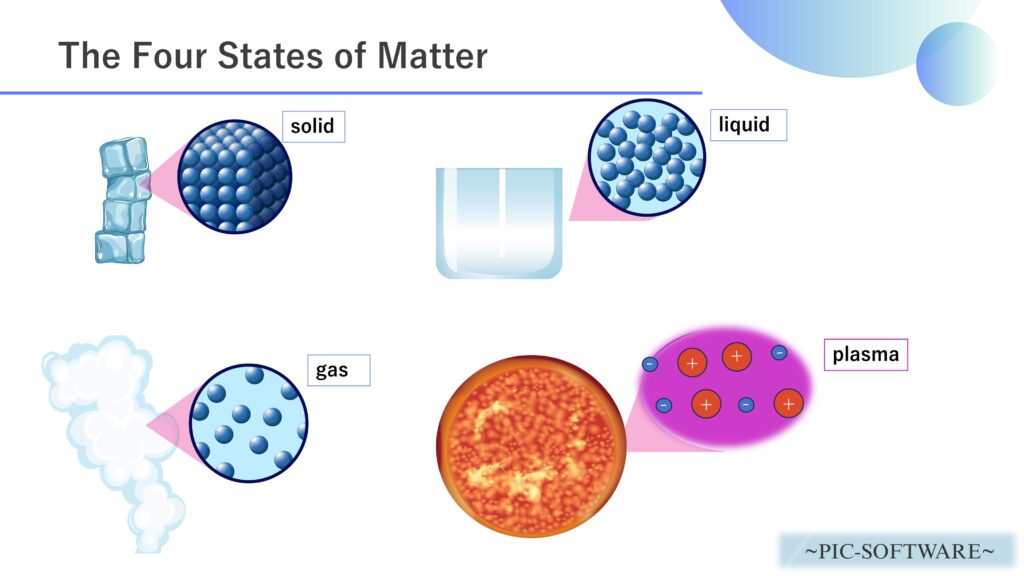
Figure 1: The Four States of Matter
Matter is commonly classified into solids, liquids, and gases, but by heating a gas further, it is possible to generate plasma.
For this reason, plasma is often described as the “fourth state” of matter.



This time, we will analyze plasma discharge using PIC-PLASMA 3D (plasma analysis software).
As explained earlier, plasma refers to a state in which an electrically neutral gas becomes ionized and contains many free electrons and ions.
In other words, plasma can be regarded as “a high-energy gas state that has become highly conductive.”
How Arc Discharge Occurs
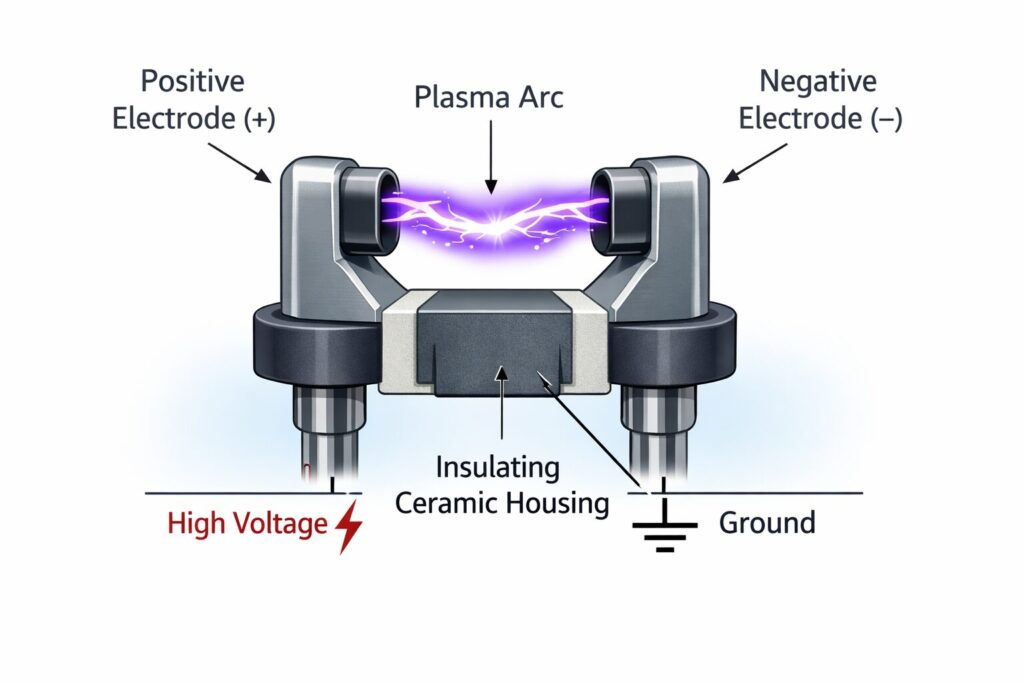
Figure 2: Conceptual Diagram of Arc Discharge in Plasma
What Is Arc Discharge?
Normally, gases such as air are insulators that do not easily conduct electricity.
However, when a sufficiently high voltage is applied between electrodes, gas molecules become ionized and split into electrons and ions.
At this point, the gas becomes conductive and current begins to flow. This is the start of discharge.
Process of Arc Discharge Generation
-
-
-
High voltage is applied: A strong electric field is generated between the electrodes.
-
Initial electrons are accelerated: A small number of free electrons present in the gas are accelerated by the electric field.
-
Collision ionization occurs: The accelerated electrons collide with gas molecules, generating more electrons and ions. As this increases in a chain reaction, a conductive path forms between the electrodes.
-
Current rapidly increases, causing light emission and heating: When a large current flows, the discharge path becomes extremely hot, and the gas turns into a strongly ionized plasma state. This high-temperature, high-luminance discharge is called arc discharge.
-
-
Arc Discharge Analysis
Let us simulate arc discharge using PIC PLASMA 3D.
The analysis model is shown below.
Analysis Model
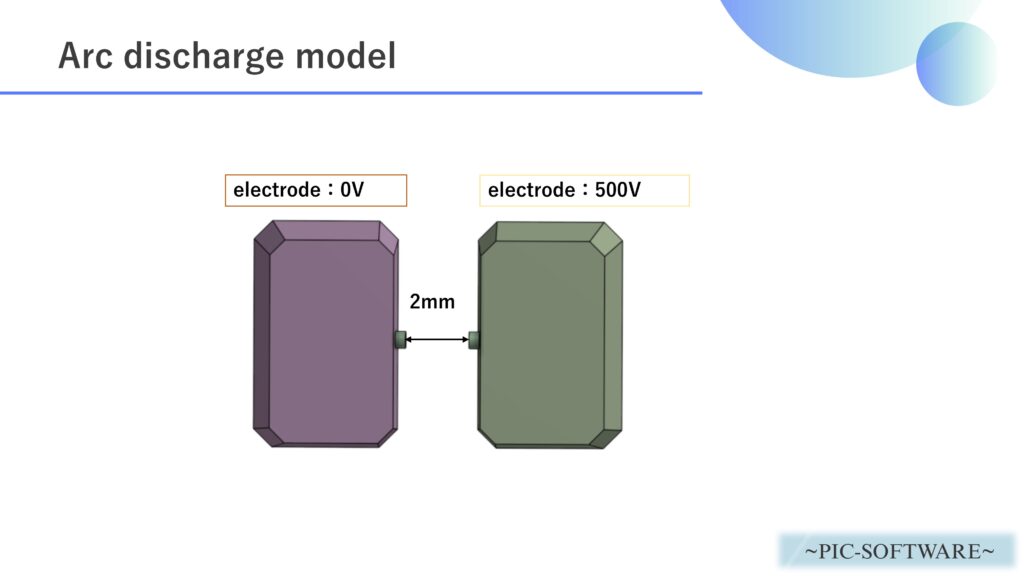
Figure 3: Analysis Model of Arc Discharge
We created an arc discharge analysis model as shown above and performed a simulation of the plasma generation process caused by collisions between electron trajectories and the atmosphere (neutral particles).
The plasma generation mechanism is shown below.
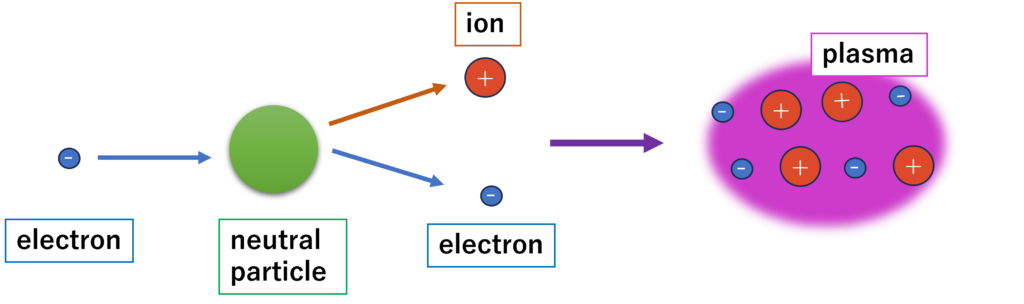
Figure 4: Plasma Generation Process
Analysis Conditions
The analysis conditions are as follows.
| Analysis Software | PIC-PLASMA 3D |
| Analysis Type | Plasma Analysis |
| Analysis Object | plasma_arc.obj |
|---|---|
| Plasma Particle Species | O₂ |
| Gas Pressure (Atmospheric Pressure) | 1.01325 × 10⁵[Pa] |
| Temperature | 300[K] |
| Voltage | electrode1: 0[V] , electrode2: 500[V] |
| Number of Generated Electrons per 1 ns | 10,000 |
| Velocity of Generated Electrons | 1.0× 10⁴[m/s] |
| Time Step | 1.0×10⁻¹¹[s] |
| Total Simulation Time | 2.0×10⁻⁸[s] |
The figure below shows the input screen for the analysis conditions used this time in PIC-PLASMA 3D.
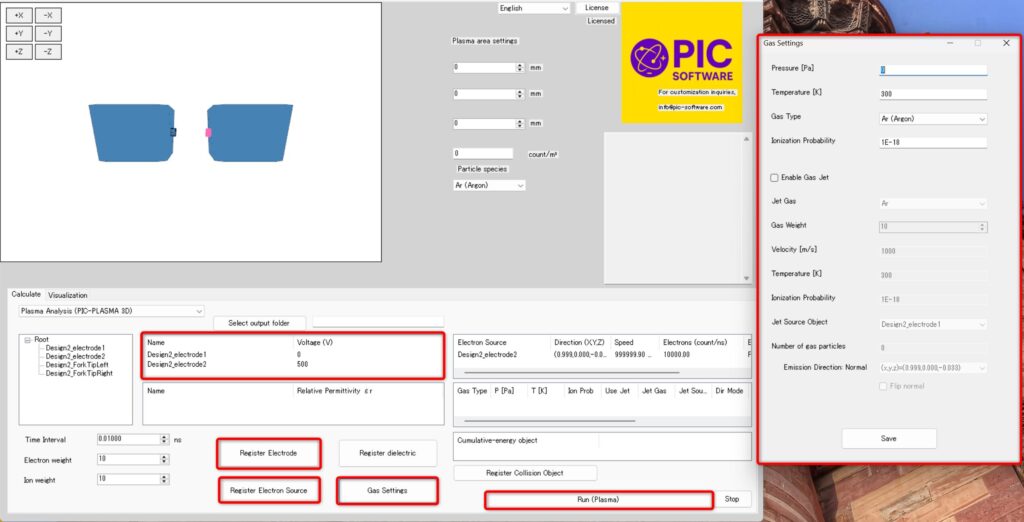
Figure 5: Analysis Condition Settings in PIC-PLASMA 3D
Analysis Results
Figure 6: Analysis Results of Interelectrode Electrons
Figure 7: Collision positions between electrons and gas
The above materials are actual analysis results calculated using PIC-PLASMA3D.
Figure 6 visualizes the behavior of electrons in plasma as an animation.
Figure 7 shows oxygen ions generated through the interaction between electrons and oxygen gas.
The CAD model used this time was created in a simplified manner, so the electrode voltages and other condition settings are also simplified.
In addition to the above calculation results, PIC-PLASMA 3D can output a wide variety of data.
- Electron density
- Current density vectors
- Electric field vectors
- Velocity vectors
- Collisions with plasma in background gas and jet gas
*The above are only examples. Please make full use of PIC-PLASMA 3D in the development of plasma products.